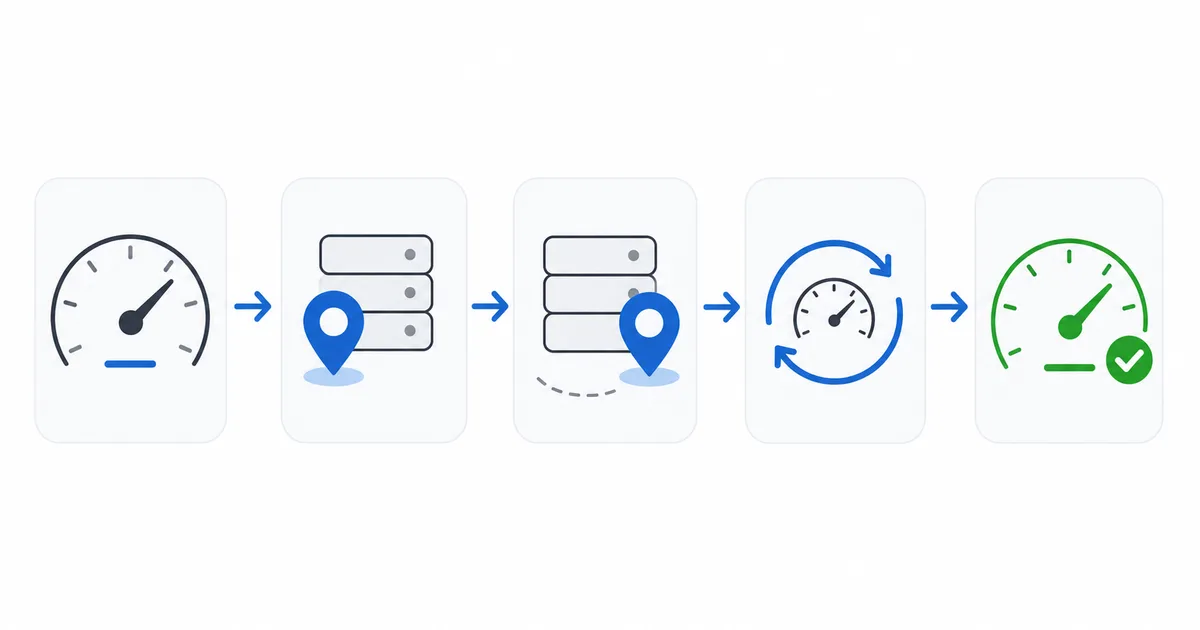
Here is exactly how we speed-test VPNs: we measure a base speed, connect to nearby and distant servers, re-test, and record the percentage of speed retained — repeated over several days, at different times, on real TV devices. We publish this so you can judge our figures for yourself. This page explains the line, the tool, the number of tests, the timing, the devices, and how we calculate speed retention.
Why We Use Speed Retention
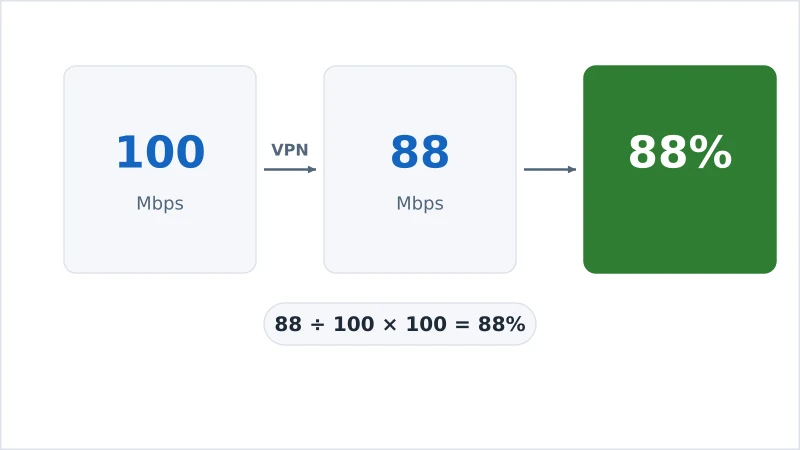
We report speed retention — the percentage of your base speed that survives the VPN — rather than raw Mbps. Here is why: raw numbers depend on our own line, which tells you nothing about your connection. Retention is independent of line speed, so if a VPN retains ~88%, you can apply that to your own speed. It is the fairest, most portable way to compare VPNs, and the figure we quote in every VPN review.
The Test Setup
| Element | What we use |
|---|---|
| Base line | A fixed European broadband connection, measured before each session |
| Tool | A consistent, reputable speed-test service, same server each run |
| Protocol | Each VPN’s fastest (WireGuard-based) protocol |
| Servers | Nearby (in/near country) and distant, per VPN |
| Devices | Computer plus real TV devices (Fire TV, Android TV, Apple TV) |
| Timing | Several days, including busy evening hours |
Keeping the line, tool and test server fixed means the only variable is the VPN itself.
The Steps, in Order
- Measure the base speed with no VPN, several times, and average it.
- Connect to a nearby server using the fastest protocol, and re-test.
- Connect to a distant server and re-test, to capture the worst case.
- Record the connection time — how long from tap to connected.
- Repeat over several days and at different times, including peak evenings.
- Test on TV devices for real streaming smoothness, not just raw speed.
- Average and calculate retention as (VPN speed ÷ base speed) × 100.
What Else We Assess
Speed is not the whole story, so alongside retention we record:
- Connection time — how quickly the app connects on a remote.
- Consistency — how much speed varies across servers and sessions.
- Streaming smoothness — whether 4K plays without buffering on a TV.
- TV-app quality — is the native app easy to use with a remote?
- Effect on ISP throttling — does encryption restore throttled video?
Honesty and Limitations
We're transparent about the limits: VPN speeds depend on your own connection, location, server load and time of day, so your results will differ from ours. That's exactly why we publish the method and use retention percentages — so our figures stay meaningful regardless of our line speed. We re-test periodically as VPNs update their apps and networks.
The Bottom Line
Our VPN speed figures come from a consistent, repeatable method: a fixed base line, the fastest protocol, nearby and distant servers, multiple tests over several days, and real TV devices — expressed as a retention percentage you can apply to your own connection. We publish it in full because trustworthy recommendations require a transparent method. It underpins every number in our VPN reviews and the fastest VPN guide.
See how we test everything on our how we test page, compare the results in the best VPN for streaming guide, and look up any term in the streaming glossary.