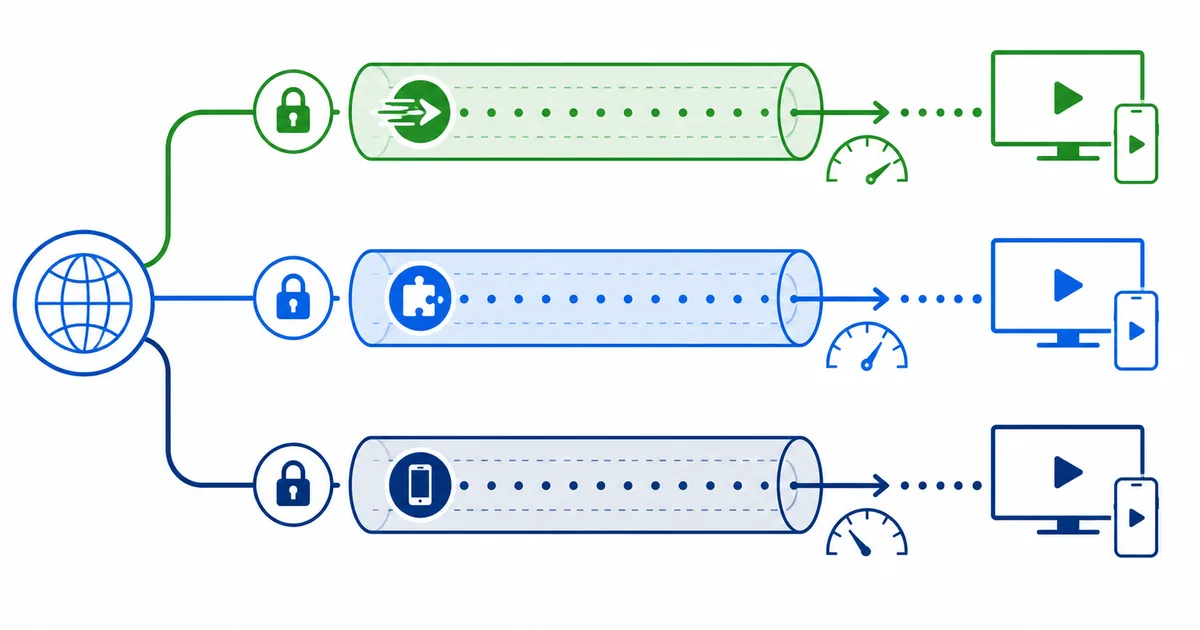
A VPN protocol is the set of rules that builds and secures the encrypted tunnel between your device and the VPN server — and it largely decides your speed, security and reliability. The three you will meet are WireGuard, OpenVPN and IKEv2: WireGuard is the fast, modern default, OpenVPN is the older and most compatible, and IKEv2 excels on mobile. This guide compares them and explains which to pick for streaming.
What a VPN Protocol Does
As covered in how VPNs work, a VPN sends your traffic through an encrypted tunnel. The protocol is how that tunnel is built and run. It sets three things you feel directly:
- Speed — how much overhead the encryption and framing add.
- Security — the strength of the cryptography and how auditable the code is.
- Reliability — how well it reconnects and gets through restrictive networks.
Different protocols strike different balances, which is why providers offer a choice.
WireGuard
WireGuard is the modern standard. Its headline trait is a tiny codebase — a few thousand lines versus hundreds of thousands — which makes it fast and easier to audit.
- Speed: the fastest of the three, with low overhead.
- Security: modern, well-regarded cryptography; small attack surface.
- Reliability: reconnects almost instantly, great for mobile and streaming.
- Trade-off: needs provider features to protect your IP; slightly newer.
Many VPNs ship their own WireGuard-based protocol (under various brand names) for exactly these speed benefits.
OpenVPN
OpenVPN is the long-established, open-source workhorse. It has secured connections for years and is trusted and battle-tested.
- Speed: slower than WireGuard due to more overhead.
- Security: strong, mature, widely audited.
- Reliability: excellent at slipping through restrictive networks, especially over TCP port 443.
- Trade-off: heavier and slower; more configuration.
Choose OpenVPN when a network actively blocks VPNs and you need maximum compatibility.
IKEv2/IPsec
IKEv2 (paired with IPsec) is fast and especially strong on mobile.
- Speed: fast and stable.
- Security: solid, using proven IPsec encryption.
- Reliability: reconnects seamlessly when switching Wi-Fi and mobile data.
- Trade-off: less effective than OpenVPN at bypassing strict blocks.
It is built into many operating systems, so it runs without extra software — ideal for phones and tablets on the move.
Side-by-Side Comparison
| Protocol | Speed | Security | Best for |
|---|---|---|---|
| WireGuard | Fastest | Modern, small codebase | Streaming, default choice |
| OpenVPN | Slower | Mature, widely audited | Restrictive networks |
| IKEv2/IPsec | Fast | Solid (IPsec) | Mobile, switching networks |
The short version: WireGuard for speed (streaming), OpenVPN for getting through blocks, IKEv2 for phones that hop between networks.
Which to Use for Streaming
For streaming, speed and quick reconnection matter most, so:
- Default to WireGuard (or your provider’s WireGuard-based option) — least speed loss, so 4K stays smooth.
- Switch to OpenVPN only if a network blocks the VPN and you need to force a connection through.
- Use IKEv2 on a phone or tablet that moves between Wi-Fi and mobile data.
Most good apps pick a sensible default, so you often need not change anything — see our best VPN for streaming guide for providers with fast WireGuard implementations. If a VPN slows your stream, the fix is usually a nearer server, not a different protocol — a point from how VPNs work.
The Bottom Line
The VPN protocol is the engine of your encrypted tunnel, balancing speed, security and reliability. WireGuard is the fast, modern default and the best pick for streaming; OpenVPN is the compatible veteran for restrictive networks; and IKEv2 shines on mobile. In practice, WireGuard on a nearby server keeps 4K smooth while adding privacy — and most apps already default to it, so you rarely need to touch a thing.
Next, understand the fundamentals in how VPNs work, or pick a provider in the best VPN for streaming guide.
Not sure about a term on this page? Look it up in the streaming glossary.