| # | Product | Rating | Price | |
|---|---|---|---|---|
| 1 | NordVPNFastest Overall | from €3.39/mo (2-yr), renews higher | Check Price | |
| 2 | SurfsharkFast & Cheap | from €2.19/mo (2-yr), renews higher | Check Price | |
| 3 | ExpressVPNMost Consistent | from €5.79/mo (2-yr), renews higher | Check Price |
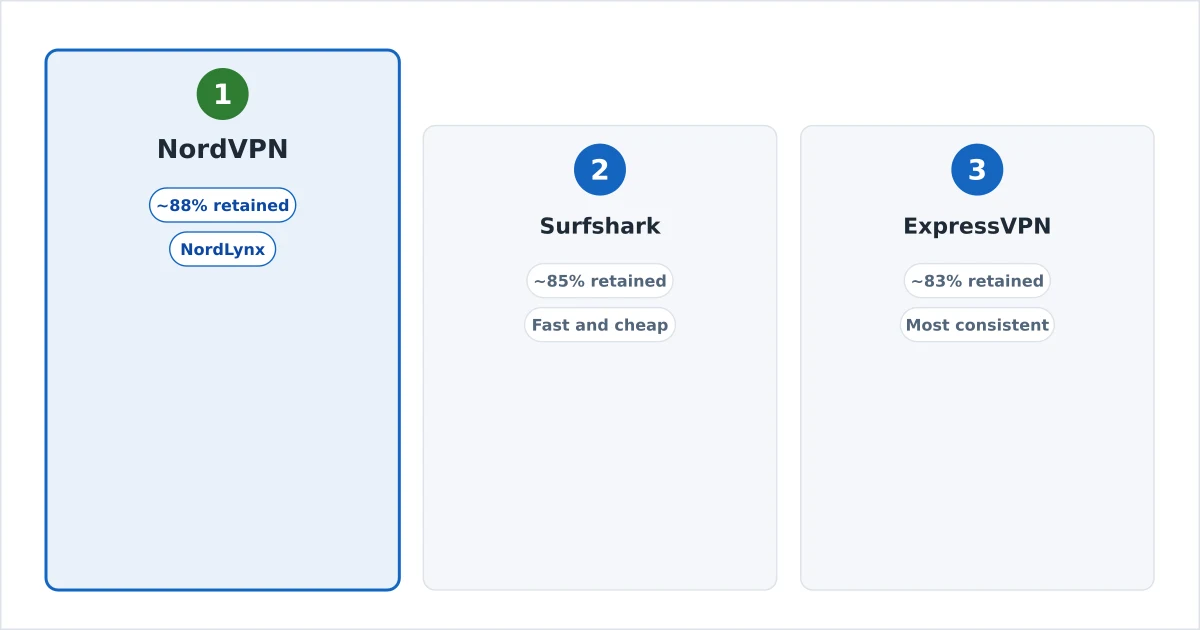
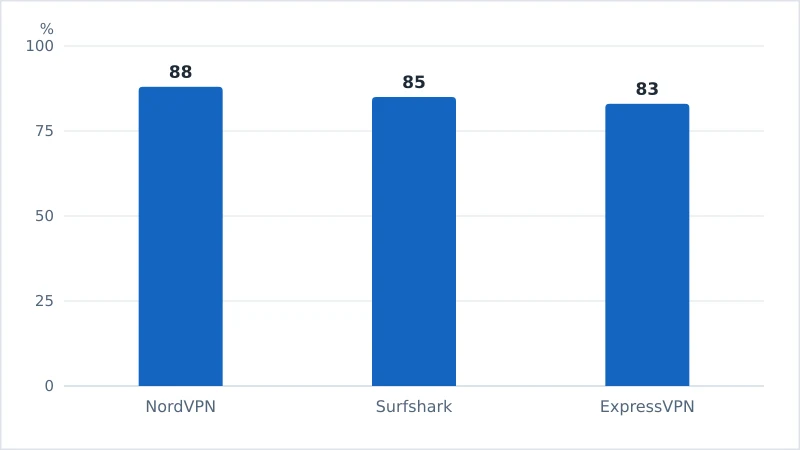
The fastest VPN for streaming is NordVPN, which retained about 88% of base speed on nearby servers in our tests, ahead of Surfshark (~85%) and ExpressVPN (~83%). All three are far faster than 4K streaming needs, but if raw measured speed is your priority, NordVPN leads. This guide ranks VPNs by real, tested speed retention — not marketing claims — for buffer-free 4K.
How We Measure Speed
Our ranking is based on measured speed retention, per our methodology: a base speed test, then re-tests on nearby and distant servers, repeated over several days and on TV devices. We record the percentage of base speed retained — the number that predicts real streaming performance. For context, 4K needs about 25 Mbps, so headroom above that means smooth playback.
The Fastest VPNs, Ranked
1. NordVPN — Fastest Overall
NordVPN topped our tests at ~88% retention on nearby servers, with the smallest drop on distant ones, thanks to NordLynx. It is also easy to drive on a TV.
2. Surfshark — Fast and Cheap
Surfshark retained ~85% with WireGuard — barely behind NordVPN — at a lower price and with unlimited devices. The best speed-per-euro.
3. ExpressVPN — Most Consistent
ExpressVPN retained ~83%, and while not the highest peak, its Lightway protocol delivered the steadiest speeds across servers — ideal if you hate variability.
Quick Comparison
| VPN | Speed retention (tested) | Protocol | Price |
|---|---|---|---|
| NordVPN | ~88% | NordLynx | from €3.39/mo |
| Surfshark | ~85% | WireGuard | from €2.19/mo |
| ExpressVPN | ~83% (most consistent) | Lightway | from €5.79/mo |
Verdict
For pure measured speed, NordVPN is the fastest VPN for streaming, with the highest retention and smallest distant-server drop. Surfshark is nearly as fast for less money, and ExpressVPN wins on consistency if steady speeds matter more than peak numbers. Honestly, all three leave ample headroom for 4K — so pick on price and features too, not speed alone.
NordVPN Pricing → Surfshark Pricing →
See the full rankings in the best VPN for streaming guide, the best cheap VPN and most private VPN guides, and look up any term in the streaming glossary.