The best ways to save on streaming in Europe are to rotate services instead of stacking them, use ad-supported tiers, build on free public broadcasters, take annual plans where cheaper, share within your household, and turn off auto-renewal — together these can halve a typical bill. This guide covers each strategy with an estimated savings table. For prices to work from, see our European streaming prices guide.
The Strategies
- Rotate, don’t stack — keep one service at a time; see our rotate subscriptions guide.
- Use ad-supported tiers — several euros less; see ad tiers compared.
- Build on the free layer — public broadcasters and FAST channels cover a lot for free.
- Take annual plans where cheaper — e.g. Amazon Prime’s yearly fee beats monthly.
- Share within your household — use the plan’s streams and family sharing; see account sharing rules.
- Consider bundles — only if they include what you’d buy anyway; see streaming bundles.
- Turn off auto-renewal — cancel what you’re not watching, resubscribe later.
Estimated Savings
Illustrative, for a household paying for three services year-round:
| Strategy | Typical monthly saving | Notes |
|---|---|---|
| Rotate to one at a time | €15–25 | Biggest single saver |
| Switch to ad tiers | €5–10 | Same content, minor ads |
| Lean on free public TV | €10–15 | Replaces some paid viewing |
| Annual plan (where offered) | €1–3 | Only if you’ll keep it all year |
| Household sharing | €5–10 | Vs separate accounts |
| Cancel unused services | €8–20 | Stops silent drain |
Stacking a few of these can halve a typical streaming bill.
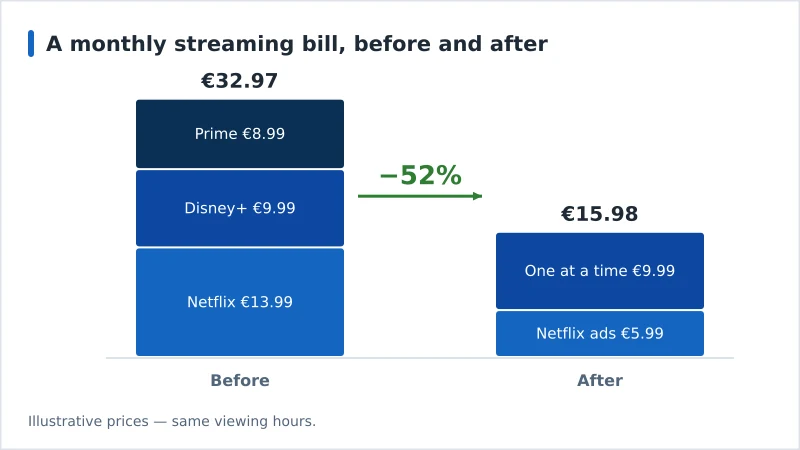
A worked example: a bill of €32.97 — Netflix Standard €13.99, Disney+ Standard €9.99, Prime Video €8.99 — drops to €15.98 by moving Netflix to its ad tier (€5.99) and rotating between the other two instead of paying for both (€9.99). That is 52% less for the same viewing hours.
A Simple Money-Saving Plan
- Anchor on free — set up your public broadcaster and a FAST service.
- Keep one paid core — the service you watch most, on an ads tier if that suits.
- Rotate a second — add one only when there’s something to watch, then cancel.
- Turn off auto-renewal everywhere and review monthly.
- Check for a bundle or annual deal — take it only if the maths works.
The Bottom Line
You don’t need to pay for three services at once. Rotate rather than stack, use ad tiers, build on the free layer, and turn off auto-renewal — that combination cuts most streaming bills sharply. Add annual plans, household sharing or a genuine bundle where they help. Compare prices in our European streaming prices guide, learn the rotate strategy and account sharing rules, see the free services, and look up any term in the streaming glossary.