Europe has the world’s strongest free public streaming: almost every country funds a public broadcaster whose channels, drama, news and archive stream free online. From the UK’s BBC iPlayer to Sweden’s SVT Play and Germany’s ARD/ZDF Mediatheken, this guide maps every major free public platform across 24 countries — what’s free, how it’s funded, and the geo-restrictions that apply. These services are the cheapest, most overlooked layer of any European streaming setup.
Why Public Broadcasters Matter
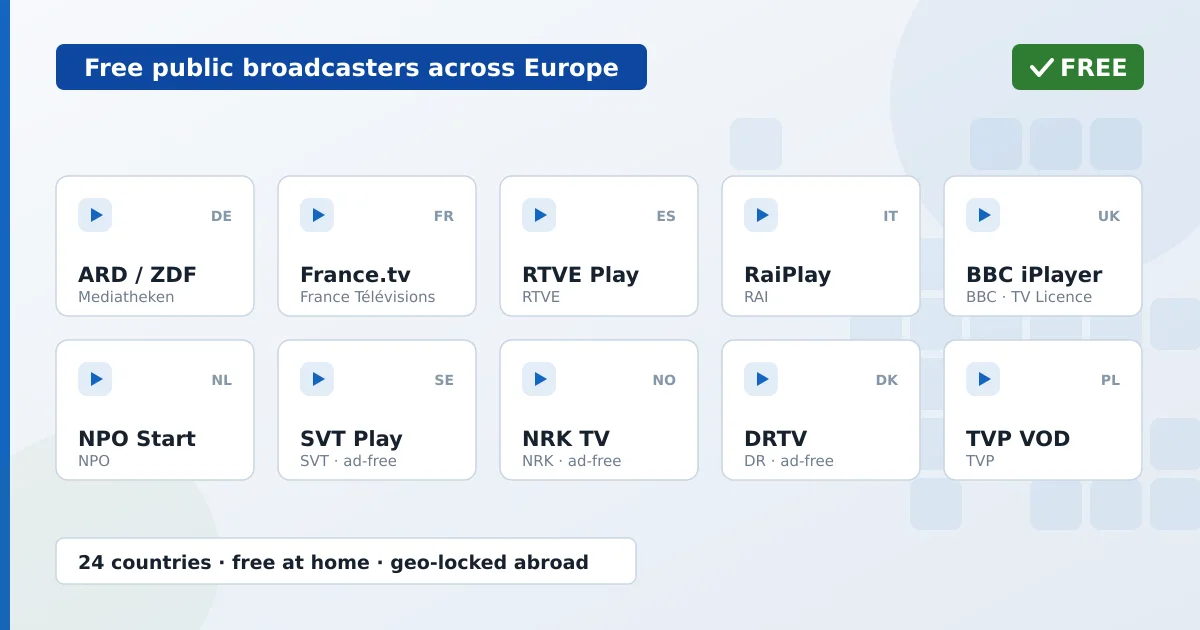
Before paying for anything, most European households can watch a large amount of licensed content for free through their public broadcaster. These are funded collectively — usually by a tax or household levy, occasionally a licence fee — so streaming is free at the point of use. They carry national drama, news, documentaries, children’s content, major sport events and deep archives. The catch is geography: each one geo-locks to its home country.
Free Public Broadcasters Across Europe
| Country | Broadcaster | Platform | What’s free | Geo-locked? |
|---|---|---|---|---|
| Germany | ARD / ZDF | Mediatheken | Channels, drama, news, archive | Yes (some rights-limited) |
| France | France Télévisions / ARTE | France.tv / ARTE.tv | Channels, replay, culture | Yes (ARTE partly EU-wide) |
| Spain | RTVE | RTVE Play | TVE channels, series, archive | Yes |
| Italy | RAI | RaiPlay | RAI channels, drama, archive | Yes |
| Netherlands | NPO | NPO Start | Public channels + replay | Yes |
| Belgium | VRT / RTBF | VRT MAX / Auvio | Flemish & French channels | Yes |
| Poland | TVP | TVP VOD | Public series, films, archive | Yes |
| Sweden | SVT | SVT Play | Channels, drama, events (ad-free) | Yes |
| Norway | NRK | NRK TV | Channels, drama, events (ad-free) | Yes |
| Denmark | DR | DRTV | Channels, Nordic drama (ad-free) | Yes |
| Finland | Yle | Yle Areena | Channels, drama (FI/SV, ad-free) | Yes |
| Austria | ORF | ORF ON | Channels, drama, news (expanded) | Yes |
| Switzerland | SRG SSR | Play Suisse | SRF/RTS/RSI, all 3 languages | Yes (non-EU) |
| Portugal | RTP | RTP Play | Channels, series, archive | Yes |
| Greece | ERT | ERTFLIX | Channels, drama, archive | Yes |
| Ireland | RTÉ | RTÉ Player | Channels, Irish drama, news | Yes |
| United Kingdom | BBC | BBC iPlayer | Channels, drama, archive (ad-free) | Yes — needs TV Licence |
| Czech Republic | Česká televize | iVysílání | ČT channels, drama, archive | Yes |
| Romania | TVR | TVR+ | TVR channels, series, archive | Yes |
| Hungary | MTVA | MédiaKlikk / M4 Sport | Channels + free-to-air NB I sport | Yes |
| Croatia | HRT | HRTi | HRT channels, drama (registration) | Yes |
| Bulgaria | BNT | BNT | Public channels, series, news | Yes |
| Iceland | RÚV | RÚV | Public channels, Icelandic drama & kids | Yes (EEA) |
| Luxembourg | RTL Lëtzebuerg | RTL Play | RTL Luxembourgish channels & catch-up | Yes |
How They’re Funded
Most European public broadcasters are funded by a general tax or household levy, which is why streaming is free at the point of use:
- Ad-free, tax-funded gold standard: SVT Play (Sweden), NRK TV (Norway), DRTV (Denmark), Yle Areena (Finland). Among Europe’s best.
- Household levy, recently reformed: ORF ON (Austria) expanded after its 2024 funding change; Germany’s ARD/ZDF run on the Rundfunkbeitrag.
- The TV Licence exception: the UK’s BBC iPlayer legally requires a TV Licence (£174.50/year in 2026) to use at all — the one place “free” public streaming carries a mandatory charge.
- Registration, not payment: some (like Croatia’s HRTi) are free but ask you to register.
- Publicly-minded, privately owned: Luxembourg’s RTL Lëtzebuerg is the de facto national free broadcaster with a public-service remit, though owned by RTL Group rather than the state.
The Geo-Restriction Catch
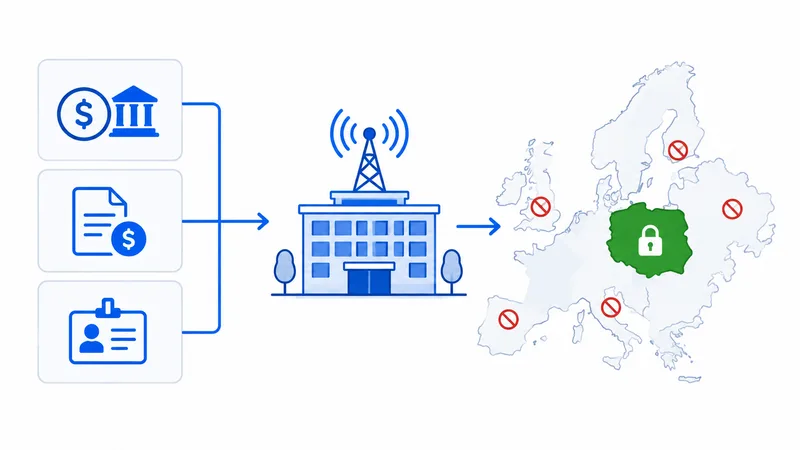
Almost every public broadcaster geo-locks to its home country for licensing reasons — BBC iPlayer works only in the UK, France.tv only in France. Two things follow:
- EU portability lets residents keep their own public service temporarily while travelling in the EU — but it never opens foreign broadcasters to you. (Non-EU Switzerland and post-Brexit UK sit outside these rules.)
- A VPN does not legitimately unlock foreign public broadcasters; they detect and block VPN servers. Use one for privacy on public Wi-Fi, not as an unblocking tool — see how geo-blocking works.
The Bottom Line
Europe’s free public broadcasters are the most valuable — and most overlooked — layer of any streaming setup: national drama, news, major events and deep archives, free at the point of use in almost every country. The Nordics and the BBC lead on quality, funding is usually a tax or levy (the UK’s TV Licence aside), and nearly all geo-lock to home. Start any setup with your public broadcaster, then add paid services only for what it doesn’t cover. See what each market pays in our European streaming prices guide, the full local picture in our streaming by country guides, the right hardware in the best streaming devices guide, and any term in the streaming glossary.