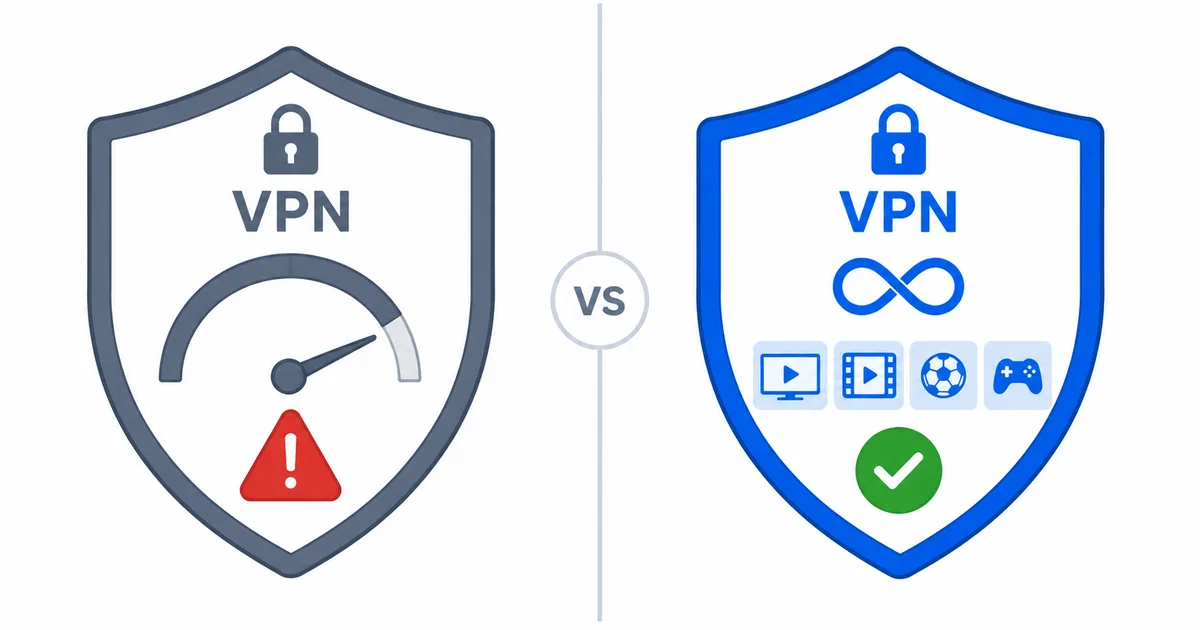
Free VPNs are not all bad, but they come with real trade-offs: data caps, slower speeds and fewer servers — and some monetise your data instead of charging you. A respectable free tier from a paid provider (like Proton VPN’s) is safe for light use; a standalone “free” VPN with no clear business model is a red flag. Paid VPNs remove the limits for a few euros a month. This guide explains the real risks, when free is fine, and which free VPNs to trust.
How Free VPNs Make Money
Running a VPN costs money — servers, bandwidth, apps and staff — so a free service has to earn it somewhere. Understanding how tells you whether it is safe:
- Respectable model: the free tier is a taster for paid plans. The company earns from subscribers, so it limits your data and speed but does not need to exploit you. Proton VPN, Windscribe and hide.me work this way.
- Risky model: a standalone free VPN with no paid product often monetises you — through intrusive ads, data collection and sale, or even reselling your bandwidth. This is the opposite of what a VPN is for.
Red flag: if a VPN is completely free with unlimited data, no paid plan, and a vague privacy policy, assume you are the product. A VPN sees all your traffic — you must be able to trust how it earns.
Free vs Paid Compared
| Factor | Free VPN | Paid VPN |
|---|---|---|
| Data | Capped (often ~10 GB/mo) | Unlimited |
| Speed | Slower, throttled | Full speed |
| Servers | Few countries | Many countries |
| TV apps | Rare/basic | Native Fire TV, Apple TV, etc. |
| Streaming | Light only | Full 4K |
| Privacy | Varies (some risky) | Audited no-logs (reputable) |
| Cost | €0 | ~€2–6/mo |
The honest summary: a good free tier is fine for light, occasional use; regular streaming needs the unlimited data, speed and TV apps of a paid plan.
Trustworthy Free VPNs
If you want a genuinely safe free option, stick to free tiers from established paid providers:
- Proton VPN — the standout: unlimited data, no ads, strong privacy, a few countries.
- Windscribe — ~10–15 GB/month, several countries, no card required.
- hide.me — ~10 GB/month, no card required, privacy-focused.
All three earn from paid plans, so they have no reason to monetise your data — which is exactly what makes them safe.
When to Pay
A paid VPN is worth the modest cost when you:
- Stream regularly — 4K uses several GB per hour, blowing free caps fast.
- Protect many devices — paid plans allow many or unlimited connections.
- Want TV apps — native Fire TV and Apple TV apps are a paid feature.
- Value speed and privacy — audited no-logs and full speed come with paid plans.
Paid VPNs start around €2–6/month on longer terms. Our tested picks are in the best VPN for streaming guide — NordVPN for all-round, Surfshark for value.
The Bottom Line
Free VPNs are not automatically unsafe — but you must know how they earn. A free tier from a paid provider like Proton VPN, Windscribe or hide.me is trustworthy and fine for light use; a standalone “free” VPN with no clear business model likely monetises your data, which defeats the purpose. For regular streaming, protecting many devices, or full speed and TV apps, a paid plan at a few euros a month is the sensible choice.
Learn the fundamentals in how VPNs work, compare the best in the best VPN for streaming guide, and look up any term in the streaming glossary.
Best all-round paid VPN: NordVPN → Best free tier: Proton VPN →